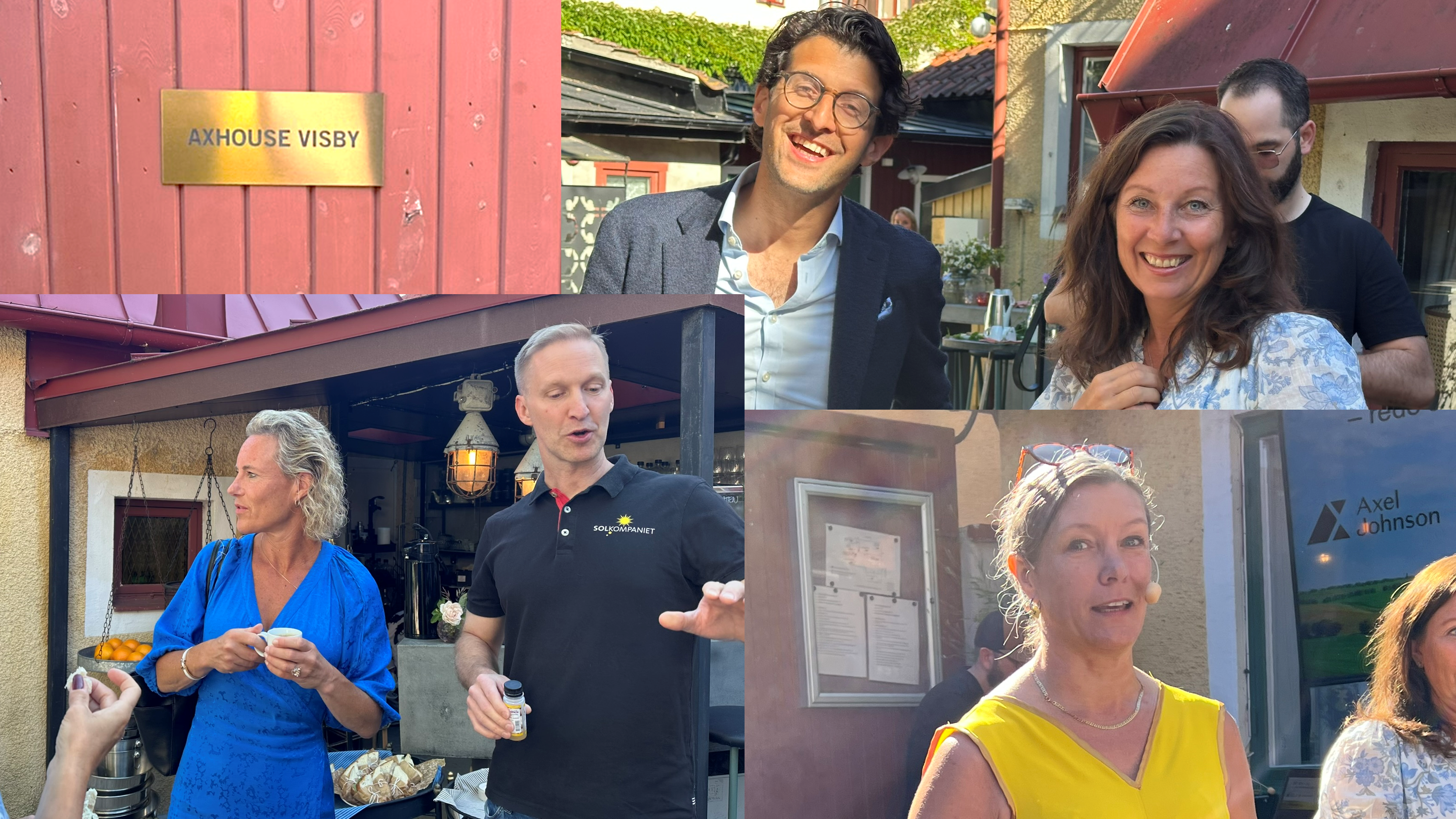
In Almedalen 2024, the Axel Johnson owned company Solkompaniet arranged a seminar and panel on the potential for solar power in Sweden. The major take aways are found in this article.
Below there are links to an english AI produced podcast from the seminar and you can also find the filmed material from the event, in Swedish.
Sweden is on the brink of a solar power revolution. With an astounding 50 gigawatts of solar projects awaiting grid connection, the potential to power millions of homes with clean, renewable energy is undeniable. However, while the opportunity is massive, significant hurdles remain, particularly in grid capacity and permitting processes. The key to unlocking this potential lies in collaboration, innovation, and strategic planning.
Bottlenecks: Grid Capacity and Permitting
The primary obstacles hindering Sweden’s solar expansion are grid limitations and complex permitting processes. Industry experts highlight the growing backlog of projects awaiting connection, emphasizing the urgency of streamlining these systems.
“One of the major challenges is grid capacity, and then of course, permitting, which can be a labyrinth,” says a leading industry professional.
At E.ON alone, 30 GW of solar projects are currently in the queue. Just a few years ago, they processed 30 major grid connection applications per year—now, they handle 50 per week. Without a more efficient system, Sweden risks losing investment interest and slowing down its renewable energy transition.
The Synergy Between Solar and Wind
An exciting revelation in Sweden’s solar potential is its complementary relationship with wind power. Research shows a negative correlation between solar and wind power production—when one is strong, the other is typically weaker. This suggests that Sweden’s grid can accommodate much more solar than previously estimated, reducing the need for costly upgrades.
“If we use the same logic seen in Varberg, northern Germany, and the rest of Germany, our grid should be able to handle up to five times as much solar as we have today without major reinforcements,” explains an expert in the field.
Investment Readiness: Certainty is Key
Investors are eager to invest into Sweden’s solar power sector but require certainty that projects will be connected to the grid in a reasonable timeframe and generate sustainable returns.
“Investment willingness is conditional upon our ability to turn this queue into real projects—getting grid connections in a reasonable time at reasonable costs, and securing permits to build these parks where they are most beneficial.”
A clear regulatory framework and predictable timelines will be crucial in maintaining investor confidence and accelerating Sweden’s solar expansion.
Collaboration and a Unified Vision
The industry agrees—developers, investors, grid operators, and policymakers must work together to create a shared vision for integrating solar energy into Sweden’s energy mix. A proactive approach, including more accurate forecasting and planning, is essential.
“No matter how fast we move, there will always be bottlenecks—whether at the transmission, regional, or local grid level. That’s why it’s so important to have a clear plan and send the right signals back to the market.”
Ensuring Project Quality
While interest in solar power is booming, concerns have been raised about the quality of certain projects. Some developers may be rushing ahead without sufficient experience, which could lead to market consolidation.
“Not all projects are created equal. Some developers may be caught up in the hype, rushing forward without enough experience or attention to detail.”
As the industry matures, stronger and more experienced players will likely dominate the market, ensuring higher quality and reliability.
Innovation Through Pilot Projects
Pilot projects play a crucial role in testing new ideas and demonstrating large-scale solar integration’s feasibility. They help address challenges such as grid constraints and economic viability while setting benchmarks for future expansion.
Economic and Social Benefits
Beyond reducing carbon emissions, solar energy can generate jobs, boost local economies, and support Sweden’s climate goals. However, careful planning is required to balance land use, community impact, and environmental considerations. Solutions such as agrivoltaics—combining solar farms with agriculture—offer promising ways to optimize land use while benefiting multiple industries.
Strategies for Overcoming Challenges
To fully realize Sweden’s solar potential, several strategies need to be prioritized:
– Streamline the permitting process by simplifying applications and increasing transparency.
– Leverage digitalization to enhance communication between developers, grid operators, and authorities.
– Proactive grid planning to upgrade infrastructure in high-potential areas.
– Encourage community-owned solar projects to increase local engagement and investment.
– Expand microgrids to enhance energy independence and resilience.
– Develop flexibility markets to optimize energy distribution and avoid grid overload.
– Establish clear maturity criteria to prioritize serious and viable projects.
The Future of Swedish Solar Power
Sweden is at a turning point in its energy transformation. While challenges exist, the opportunities for solar energy are vast. The key lies in creating a streamlined, efficient system that allows Sweden to fully harness the power of the sun. With the right policies, investments, and collaborations, solar power will become a cornerstone of Sweden’s energy future, ensuring a cleaner, more sustainable, and competitive power system for generations to come.
“Solar and wind have the potential to become the new baseload power, not just in Sweden but globally.”
“It’s incredible what is possible with innovation, collaboration, and a shared vision for a better future.”